Blog Navigation:

2009/11/18

Biblical Paintings

During my M.F.A., I felt the strong desire to create a series of Biblical paintings.  The series is probably the most difficult art project I have ever faced.  However, through the hard work I learned more about my art and more about my faith.

I could not have made it without the care and prayers of my friends and family.  I am grateful for the Pensacola Christian College staff, in particular Mr. Joseph Digangi’s encouragement in difficult times, and fine artist Brian Jekel’s and illustrator John Taylor’s skill and expertise that guided me through.  I am especially grateful for my family's help and encouragement through my months with very little sleep.  Also, I am ever more grateful to my Lord and Savior Jesus Christ for His sustaining power.  Making a series of paintings is so insignificant compared with His incredible love and mercy.

For this massive digital project, I wanted to create the appearance of fine oil paintings.  I researched and sketched just like normal.  However, the paintings were ten times the size of anything that I had ever done on the computer.  How could I put ten times the amount of detail into a painting in the same amount of time as normal?  Practice, perseverance, and prayer.  I had never worked on anything over 100 megabytes, and for these projects the file sizes were easily 5 times that.  Some paintings took a half an hour to save.  Often I would wait too long before saving and would lose important work in a program crash.  This experience would help me in the future when I worked on a project 6+ gigabytes (that's 6000+ megabytes).

As challenging as the technical aspects proved, the real benefit of the project had nothing to do with gained knowledge or skill.  The real benefit lay in the viewers who drew inspiration and comfort from the messages within the paintings.


Enoch Translated shows the character hovering between physical existence and spiritual existence—a life after this current life.  From the very beginning of Genesis, the Bible shows that this life is not the only existence.  This illustration is a fanciful look at what the world and people might have looked like before Noah’s flood, and how a translation between worlds might have looked.
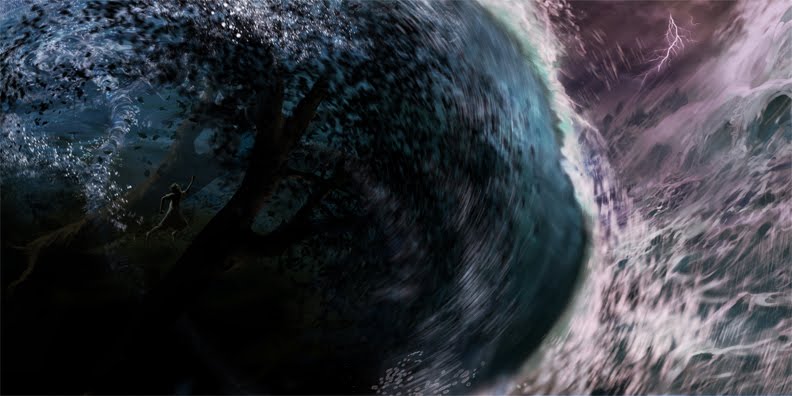


Unfortunately, like closed systems in the famous law of thermodynamics, men tend toward degeneration.  Noah’s flood is a harsh example of the results of evil in men’s hearts.  The Bible describes how the entire earth was flooded by God because of the detestable acts of humanity.  He allowed one man, Noah, to escape with a specially designed ship that floated above the devastation caused by the ravaging waves.  Deluge portrays how the powerful, destructive waves might look.


After the Flood, men degenerated again.  Humanity invented gods to worship instead of worshipping the great God.  They also twisted the practice of sacrificing animals to appease God to the practice of sacrificing their own children.

When God called Abraham audibly, the call was unusual.  Usually God works silently as men live their own lives.  When God promised Abraham a son at hundred years of age, that was unusual too.  But when God told Abraham to sacrifice that son, that was anything but unusual.  All the cultures around Abraham worshipped their wooden and stone idols by child sacrifice.  Child sacrifice, though a sad practice, was the norm at that time.

In Abraham and Isaac, I imagined the horror of the event as Abraham walked steadily to the altar where he would kill his son to appease his God.  However, God did not let Abraham touch Isaac.  By setting this example, God showed that He would never require child sacrifice.

Unfortunately, some cultures still practice child sacrifice even today.  They need to realize that their child’s death cannot pay for their guilt.


Isaac eventually grew up, married, and had kids, and eventually his descendants were known as the nation of Israel.  For several hundred years the Israelites lived in Egypt, but then they moved back to the same country Abraham and Isaac had originally lived in.

I try to find unusual moments to illustrate.  In Rahab's Vigil, I took an event that is not specifically mentioned in the Bible.  Rahab sheltered the spies from Israel, and in turn they promised protection in the future destruction of her city.  This shows Rahab waiting the return of the conquering Israelites.  The scarlet rope that she used to save the spies hangs out her window, a sign for the Israelite army to leave her alone.


In Return of the Ark, some Israelite harvesters hear the bawling of the Philistine cows bearing the Ark of the Covenant on a cart.  The Ark was the most precious item of worship between the Israelite’s and the God who made heaven and earth.  The Israelites had begun to think of the Ark as the object of power and worship and had carried it into battle to guarantee their victory.  The tactic did not work.  The Israelites had lost the battle, and the Ark had been captured by the Philistines.  However, the Philistines discovered that they were being punished by plagues and eventually sent the Ark back.

Really, the story illustrates how we humans try to manipulate God.  Just because we have a connection with God does not mean that He will obey our every beck and call.  If we harbor hate or evil in our hearts, He has no prerogative to save us.  However, He will redeem us, if we are willing.


As generations passed, the Israelites slowly left the God of Abraham and Isaac.  The Lord would send prophets, such as Elijah in this painting, to call the Israelites back to Himself.  In Fire From Heaven, Elijah has just prayed that God would ignite the bull sacrifice that he had just soaked with water.  Earlier in the day the priests of another god had tried to call down fire from their god.  Though they screamed and cut themselves all day, the skies had remained silent.  The moment Elijah prayed to God for fire, God let forth a dazzling display of the elements, and the fire entirely consumed the altar, sacrifice, and water.  Unfortunately, the Israelites did not turn back to God afterwards.


Signs and wonders only last a generation or two at most.  A prophet’s work rarely lasted longer than his short unpopular life.  However, one Israelite's work has changed the world in incredible ways.  Born to a poor couple in Bethlehem under the Roman occupation of Israel, Jesus would do more than show signs and wonders.  In fact, he claimed to be God’s son, and to be eternal.  Jesus’ unique attribute of being one with God is called the "Hypostatic Union."  Heaven in His Eyes tries to capture some of the wonder of that confluence of heaven and earth.


Hath Ears to Hear explores the reactions of the people to Jesus' teachings.  The people at Jesus' time did not really know what to think about him.  Some thought he was an ancient prophet come back alive.  Some thought he was a political leader who would deliver the Israelites from the Roman occupation.  The religious leaders in that day caught his steady references to his divinity within his teachings on moral living before God.  The tension between his healing miracles, his radical teaching, and his claims to Deity caused a lot of talk in the country.  Jesus attracted quite a crowd.  Some travelled great distances to see him.  Some followed him everywhere.  Many heard him, but none understood him.


In this painting, I painted the city of Jerusalem from the side of Golgotha.  I was unable to find any paintings or photographs of the city from this side.  From topographical maps and my study into Herod's temple, some photos of the Holy Land Experience in Orlando, Florida, and other historical references, I created this view of the city.

Jerusalem, Jerusalem portrays the darkness that descended on the city as Jesus died for the sins of the city and for humanity at large.  The title for the painting comes from Jesus’ lament: "O Jerusalem, Jerusalem, thou that killest the prophets, and stonest them which are sent unto thee, how often would I have gathered thy children together, even as a hen gathereth her chickens under her wings, and ye would not!" (Matthew 23:37)


The mission of Jesus did not end with his death.  Instead, historical records indicate that several hundred people saw him ressurrected and heard him teach for several weeks after his death.  Mystery at Emmaus explores the surprise of the two followers as they recognize their Savior just as he vanishes.  According to the Bible, he sent his Holy Spirit to do his work in each individual believer's heart.  Even though the believers long for his physical presence, his Spirit remains to comfort and guide us in our spiritual existence.

2009/11/14

Religious Illustration

The A Beka Book illustrators were finishing the Joyful Life Sunday school curriculum, when I began working there.  I enjoy creating art with deep meanings, and really loved working on the Joyful Life curriculum and other Christian materials.

When I create religious art, my process is the same as with any other artwork.  I do a lot of historical research to understand how the world looked like at that time, how people dressed, and what cultural customs controlled society.  Then I do a lot of compositional sketches to get an original, interesting composition.  By that point I have usually chosen a style for the project.  The illustrations just become a matter of time and energy after that point.


I actually illustrated as an intern for A Beka Book in January, 2003.  During the two weeks that I worked there, I created seven to ten illustrations.  I think only this illustration and it's companion illustration survived to be published as part of the Joyful Life curriculum.


The two illustrations are important to me because some religious publications have shied away from addressing any racial issues.  A Beka Book, thankfully, embraced the diversity of racial and cultural experience.


My boss grew up in Mexico, and I benefited from his experiences as I created this illustration.  I constructed it so the chaos on the left side of the picture contrasted with the family's situation on the right side.  After these years, I still like the dog.


Intergenerational relations has become more and more important to me through the past few years.  I hope the younger generations get to connect with their older relatives and associates.  A lot of accumulated wisdom is disappearing from our culture, and the younger generations often feel lost, without roots, as they approach the age of decision.  With this illustration, I tried to emphasize the joy of child, parent, and grandparent interaction.


No collection of my Joyful Life work would be complete without one of my song visuals.  The song Little by Little talks about perseverance in climbing mountains, but my song visual applied the message to something kids deal with in their daily lives: cleaning their room.  While addressing the serious issue, I squeezed just about every toy that I every played with as a child, and many toys that I wanted from toy catalogs and friend's houses.  Just like cleaning a room, difficult projects can be solved with perseverance, one step at a time. 


This is a father-son moment between Joseph and Jesus in the carpenter's workshop.  I love learning about different cultures, and often people do not consider that ancient Israel was a completely different culture than our own.  Not only did they have different technologies (notice the carpenter's tools in the illustration), but they also communicated differently and acted differently in public.  I try to work my growing knowledge of the norms of that time and culture into my illustrations.


When creating illustrations for children, many times the illustrator must make the pictures simpler, but not always.  Children really are smarter than people give them credit for being.  I prefer to test my work on kids if it involves any kind of interaction like in this illustration.


When working on the Growing Up Where Jesus Lived second-grade reader, my coworker John Ball and I collaborated on the above hard-edged style.  Sometimes the aesthetic compromises caused problems, such as how to show wind with a hard-edged shape, but simplifying the art helped me grow as an artist.


When creating this epic illustration of the yearly journey to Jerusalem, I researched the area heavily.  This shows Herod's temple from the top of the Mount of Olives.  The road travels in between the wealthy housing on the right and the cemeteries on the left.


As a parting illustration, I offer this illustration on helping each other.  In the story the red-headed girl is scared to help at a local soup kitchen, but through the story she learns to give from her heart and gains a friend.  Too often people get scared to reach out in love to help others for fear that people might take advantage of them.  I have found a few who will take advantage, but many seem genuinely touched, and I still have valued friends to this day, because I gave.

I post this at Thanksgiving time.  While it's good to be thankful, now's a good time to give others something to be thankful for!

2009/11/11

A Beka Book Illustration Styles

When I worked at A Beka Book, I employed a variety of styles.  Each story seemed to demand a unique treatment.  The color choice, "medium," and level of representation changed depending on the kind of assignment.

Because I use many different styles, I view stylistic variations differently than an artist who has used the same style for his entire career.  Some feel that a style is a unique way of working which separates one artist from his competition.  I view style more as an aesthetic choice.  I try not to make styles in a scientific way, but instead use them intuitively to reflect the mood of the story.

The following illustrations span my 6 years in A Beka Book.  They highlight my experiments and successes in the art of stylistic expression.


When I first started, I used colored pencils because, even with my training in acrylic, oil, and other mediums, I could create the illustrations faster with pencils.


After my publisher had their quota of colored pencil illustrations, I tried watercolor with mixed success.  Line and wash could be very fast, but I never entirely mastered it.


Then I discovered the computer.  I could create the line and wash with a great amount of detail in a relatively short amount of time.


Of course, by minimizing the amount of detail, a clean style could result.  This illustration is based on a style that a coworker, John Ball, liked to work in.


Though I enjoyed the speed of the computer, I realized that traditional media had a visual integrity that was missing with the streamlined flat computer art.  I began to try to capture some of the vitality of traditional mediums with texture and brush effects.  For this illustration, I painted under a pencil sketch, preserving the sketch in the linework and texture.


For this series of illustrations, I tried to make the artwork look like an old watercolor sketch illustration.  I did the linework on the computer using a custom brush that lent itself to an older look.


With line and wash, the line defines the artwork, and wash beneath the line can be almost anything, as evidenced by this donkey shaving illustration.  For this illustration and its companion illustration, I used edited photographs for the "wash" under the lines.  The unique style helped set the story apart as a fun departure from reality.


Medium impossibilities become possible under the guise of digital painting.  In this illustration, I tried to mimic pastel under the linework.  Practically an impossibility in real life, it works out beautifully in this ode to intergenerational involvement.


I used the same pastel and line style for this illustration, but whereas the previous illustration depended on the linework, this illustration depends on color and value to define the shapes.


Ultimately, I wanted to mimic the look and feel of oil paint.  It's great that a fast, forgivable medium can mimic the grand look of some of the great masterpieces of art.  The oil-paint appearance creates a professional look with which only photographs can compete.


The "oil technique" can be created even with a normal Photoshop brush, without any texture at all.  For the "clock" illustration, I just used color, value, and brushstroke variation to create that slick "oil" look.  Illustrators J. C. Leyendecker, Haddon Sundblom, and others employed the same techniques in their real oil illustrations.


As I searched for a faster medium with the visual integrity of fine art, I developed a new technique.  The illustration above is the first to use the technique.  I created black color fill layer over the white background and into that layer I erased and painted until I had the final drawing.  I then added three color adjustment layers to "stain" the drawing, thus colorizing the black fill layer.  I worked very hard in this style for a while and most of my work from this era is in the style.


This illustration is more refined in it’s use of the new illustration technique.  The style has the potential for quick detail, however I abandoned the style in favor for more traditional looks.


As a parting illustration, this is as close as I ever got to achieving the look of watercolor.  The process took too long, so I abandoned the style.  Still, what I learned from this illustration helped in later illustrations.


Definitions: Clarity

The title must be readable and attractive.  Characters and situations must be accurate.  Period.

Growing up, my siblings and I would bemoan some book covers merely because the blond heroine usually ended up being a brunette or a redhead.  The books that had such disparaging illustrations were avoided on that basis, unless the story had some powerful element that overcame our dislike of the illustrations.  As I grew older, I realized that many other boys and girls felt the same way.  Now when I illustrate a story, I will read the story completely and will often list details from the story for later in the illustration process.

Clarity is a catch-all for the details that signal a finished illustration.  Not only should an illustration clearly illustrate the story, but the title should stand out clearly on a cover illustration.  The illustration should not look awkward with type.  Readers should recognize the important characters immediately.  The texture, or lack thereof, should not distract from the illustration.  The detail should be well-balanced throughout the picture.  Sometimes a change in value or the addition of subtle outlines helps make a picture more clear and finished. 

Of course exceptions happen, or time requires a less thorough attention to detail.  However, most illustrations should exhibit this clarity.

Definitions: Fine Art

How can I raise the quality of this illustration?

An illustration with better workmanship will often attract the audience's eye over a poorly crafted picture.  Even if an illustrator has a strong initial idea, the execution of that idea determines success of the illustration.  In fact some illustrations succeed over others not because they have more thought put into them, but rather because they are better executed.  The execution of the illustration validates that illustration to the audience.

A foundation in fine art should never be used as an excuse to override the customer's preference.  If a disagreement in taste occurs, it is the illustrator's responsibility to offer both variations for the customer's examination (if time allows).  While fine art helps validate the illustration in the reader's mind, there can be taste differences that do not change the illustration's effectiveness.

Because of my fine art education, I look at illustrations differently than most people.  I look and see if the composition looks complete with both value and color pattern, and whether the major shapes in the illustration go well with each other.  I also know how painterly to be and when to hold back on the texture to preserve the clarity of the illustration.  All these subtleties only add strength to what's illustrated.

Definitions: Audience

Who needs to be attracted to the content the most?

A kindergarten student will probably not understand or be captivated by a technical drawing.  Neither will a preteen boy enjoy a book with illustrations geared to preteen girls.  A story must capture the audience that it's intended to reach.

Age differentiates the audience.  So does geography.  So does the surrounding social culture.  So does the political atmosphere.  So do major events in their lives.  Parents who have lost children may look on things differently than parents who have not.  By listing the intersecting sectors of society, a target audience emerges. 

At times the many factors can confuse illustrators.  Why can't we just make pictures?  However, knowing how the target audience thinks and what they value can really aid the artist as he creates illustrations that have meaning for the audience.  And if an audience finds meaning in an illustration, the story becomes all the more powerful in their eyes.

Definitions: Meaning

What visuals are most appropriate and interesting within the content?

In the past some illustrators have almost prided themselves in illustrating the forgotten parts of a story.  The would turn an obscure reference to some subtle emotion into a full-blown illustration.  Sometimes they won awards, sometimes they created artwork that they really liked, but sometimes their illustration had little to do with the real story.

An illustrator should choose points in the story or elements from the concept that make the story or concept more meaningful to the audience.  What are the major events within the story?  How can the concept be broken up into smaller concepts?  What emotions?  What events best emphasize the emotions?

As an illustrator I try to create the major emotions in the story with the few illustrations that I have.  Emotions create a sense of meaning in the audience.  The readers can relate better to the stories because the feel them in the depths of their souls.